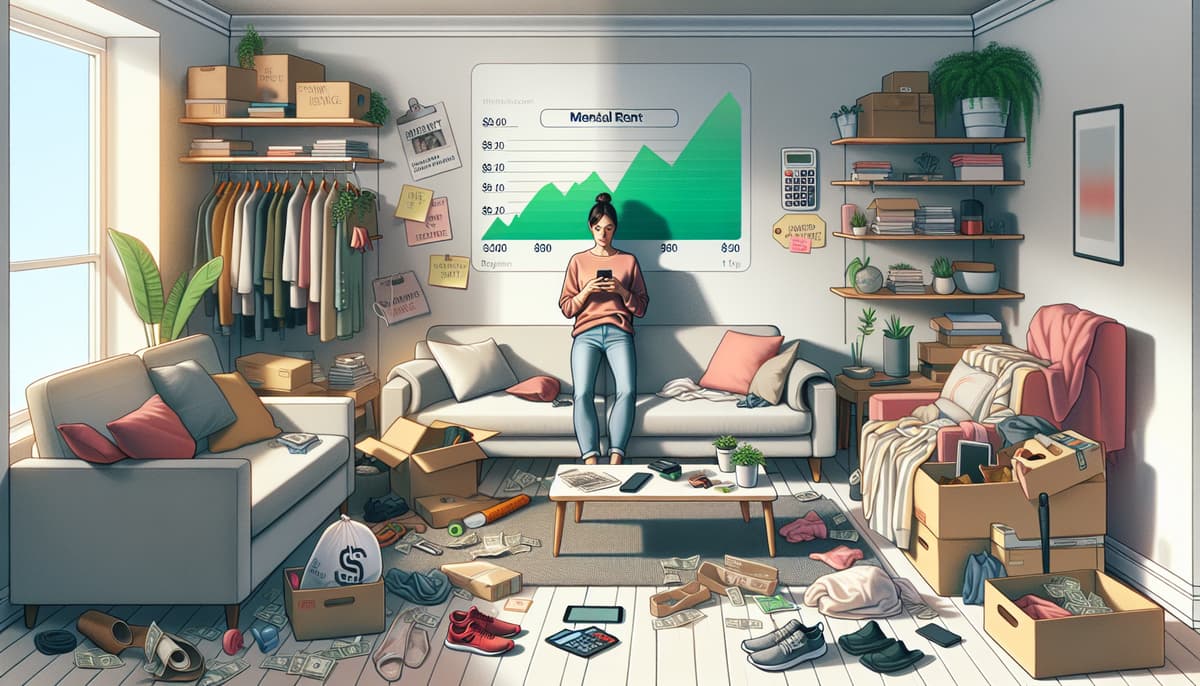
You know that tight feeling in your chest when you open your banking app?
Rent’s up.
Groceries are up.
Insurance feels like it’s auditioning for a luxury brand.
And somehow, even though you are trying to be responsible, budget better, hustle harder, the anxiety lingers.
Here is the uncomfortable truth most people skip over.
Your rising cost of living anxiety might not just be coming from the economy.
It might be coming from your own house.
Not because you are hoarding.
Not because you are reckless.
But because your cluttered home is quietly operating like a subscription service you never consciously signed up for.
And once you see it, you cannot unsee it.
Let’s talk honestly about how decluttering reduces cost of living anxiety, not in a Pinterest worthy way, but in a grounded, financially intelligent, future proof way for 2026 financial anxiety minimalism.
Your Home Is Charging You Monthly
Imagine walking into your living room and seeing a stack of unused workout gear, old electronics, décor in boxes, clothes you have not worn in two years.
Now imagine each item whispering, “I cost you.”
Because it does.
Every possession carries five hidden price tags:
- Purchase cost
- Storage cost per square foot
- Maintenance or replacement cost
- Insurance coverage cost
- Mental bandwidth tax
When we talk about financial stress from possessions, this is what we mean. Not guilt. Not shame. Math.
According to Federal Reserve data, household debt levels and consumer pressure have remained elevated in recent years. People are carrying more, paying more, and feeling it. But here is the piece rarely discussed in cost of living anxiety coping strategies.
If your home requires more space, more storage bins, more shelving, more cleaning supplies, more insurance riders, then your belongings are acting like tiny recurring bills.
A larger home to store excess things can mean higher rent or mortgage. More utilities. More heating. More cooling. More maintenance.
That is not aesthetic clutter.
That is structural expense.
This is one of the clearest examples of how decluttering reduces cost of living anxiety. When you reduce physical volume, you often reduce financial drag.
And suddenly, the problem feels less abstract.
It is not just inflation.
It is inventory.
The Psychological Invoice of Clutter
Let me share something personal.
A few years ago, I had a storage unit. Nothing dramatic. Just “temporary.” You know how that story goes.
I was paying monthly to protect items I had not touched in over a year. Every time I thought about it, I felt slightly behind in life. Slightly disorganized. Slightly off.
That subtle hum in the background?
That is cost of living anxiety amplified by unfinished decisions.
Clutter creates open cognitive loops. Your brain processes unfinished tasks as threats. Every unused item is a quiet reminder that something is unresolved. Return it. Fix it. Sell it. Organize it. Deal with it.
Multiply that by a hundred objects.
No wonder you feel tired.
Financial stress from possessions is not just about money leaving your account. It is about energy leaving your nervous system.
Research on cognitive load shows that excess stimuli reduce focus and increase stress. Your home should be where your nervous system powers down. Instead, for many people, it is a warehouse of deferred choices.
When people ask me how decluttering reduces cost of living anxiety, this is one of the most underrated answers.
Because a calm space lowers impulsive spending.
A calm space increases clarity.
Clarity leads to better financial decisions.
And that becomes compounding peace.
Calculate the “Mental Rent” You Are Paying
Let’s get practical.
If you want to understand how decluttering finances changes your reality, do this exercise.
Step one. Estimate your cost per square foot.
If you rent, divide your monthly rent by your total square footage.
If you own, estimate mortgage, taxes, and insurance monthly total, then divide by square footage.
Now look at that pile of unused items in the guest room. The garage. The closet that barely shuts.
How many square feet are they occupying?
Multiply.
That is the monthly “mental rent” your unused stuff is consuming.
For example, if you pay 2 dollars per square foot and 50 square feet of your home is purely storage for unused items, that is 100 dollars per month.
One thousand two hundred dollars per year.
Just for space.
This is where 2026 financial anxiety minimalism becomes strategic, not trendy. We are not decluttering to look cool on Instagram. We are decluttering finances to reduce structural overhead.
Because every dollar not tied up in storing yesterday’s impulses is a dollar that can cushion you against rising costs today.
That shift alone can significantly reduce cost of living anxiety, because now you have margin.
And margin is emotional oxygen.
Clutter Triggers More Spending, Not Less
Here is something cheeky but true.
Clutter lies to you.
When you cannot find what you already own, you buy another one.
When your wardrobe feels chaotic, you say, “I have nothing to wear,” then swipe your card.
When your pantry is disorganized, food expires, then you rebuy it.
That is not a personality flaw.
It is a systems flaw.
Financial stress from possessions often snowballs because clutter hides assets in plain sight. You literally cannot see your resources, so you duplicate them.
One of my clients found three unopened packs of batteries while buying more. Another had five black sweaters, all slightly different, all forgotten.
It would be funny if it did not add up so quickly.
This is why how decluttering reduces cost of living anxiety is directly tied to awareness. When everything has a visible, intentional place, you consume more consciously.
You stop shopping for chaos relief.
You stop spending to compensate for overwhelm.
And that is a powerful cost of living anxiety coping strategy that no budgeting app can fully replicate.
Minimalism as Economic Risk Management
Let’s zoom out.
Inflation fluctuates. Job markets shift. Unexpected expenses happen.
We cannot control macroeconomics.
But we can control inventory.
In 2026 financial anxiety minimalism is less about white walls and more about resilience. When your lifestyle requires less, you need less to sustain it.
If you lose income temporarily, a lean household absorbs shock better than an overextended one.
Lower fixed costs equal greater flexibility.
Fewer possessions equal fewer things to repair, replace, insure, and emotionally manage.
This is one of the most solid explanations of how decluttering reduces cost of living anxiety over time. It converts fixed pressure into variable freedom.
And freedom reduces panic.
If you want deeper insight into how lifestyle design intersects with financial peace, explore more conversations around intentional living at https://livingthezerolife.com/blogs. The themes consistently point back to ownership of decisions, not ownership of excess.
Minimalism is not deprivation.
It is strategic simplicity.
A Simple Framework to Start Decluttering Finances
You do not need a bonfire in the backyard or a dramatic weekend purge.
Start with categories that create the highest financial stress from possessions.
- Unused subscriptions tied to physical items, think storage units, extended warranties, rentals
- Duplicate household goods
- Clothing that does not fit your current lifestyle
- Old tech that holds resale value
Ask three powerful questions:
1. Would I buy this again today at full price?
2. Is this item earning its square footage?
3. Does this possession reduce or increase my cost of living anxiety?
Sell what holds value. Donate what does not. Release what drains mental energy.
Then redirect any proceeds or savings into an emergency fund or debt reduction. That completes the psychological loop. You are not just removing clutter. You are building security.
That is how decluttering finances becomes measurable progress.
And the momentum feels addictive, in the best way.
The Emotional Relief Is Real
Let’s come back to the feeling.
Imagine walking into your home and sensing space. Breathing room. Clear surfaces. Intentional ownership.
Your bills might not change overnight.
Inflation may still be a thing.
But your relationship to your environment shifts from chaotic to controlled.
Cost of living anxiety often feels like drowning in forces you cannot influence. Decluttering is a rare lever you can pull immediately.
You are reducing inputs.
Reducing maintenance.
Reducing decision fatigue.
Reducing risk exposure.
That is not cosmetic minimalism.
That is applied financial strategy wrapped in calm.
And in a world obsessed with earning more, sometimes the bravest move is simply needing less.
If you have been searching for how decluttering reduces cost of living anxiety, the answer is not mystical. It is mechanical and emotional at the same time. You are lowering fixed expenses, reclaiming square footage, cutting cognitive load, and interrupting impulse spending.
You are redesigning your economic baseline.
Start small.
One drawer.
One shelf.
One awkward corner you avoid looking at.
Each item released is a tiny cancellation notice sent to a subscription you never consciously approved.
And over time, those cancellations compound.
Cancel the subscriptions your stuff never asked permission for; watch your anxiety invoice shrink to zero.