The Drawer That Mocked You This Morning
You know the one.
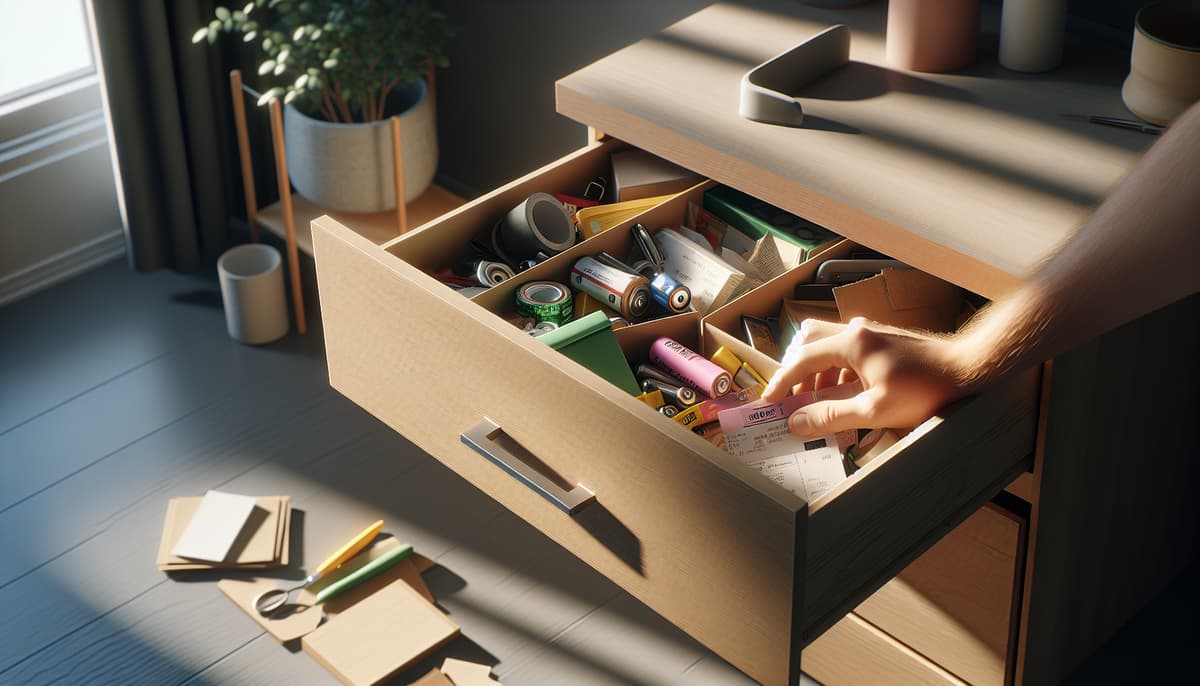
The drawer you open every day, the one that sticks slightly because it is packed too tight. Batteries that may or may not work. Takeout soy sauce packets. Old receipts from who knows where. Three pens that do not write and one that leaks like it has emotional baggage.
You close it quickly and tell yourself you will deal with it later.
If you are doing this declutter challenge with me, today is that later.
But here is the shift.
We are not gently tidying. We are not organizing chaos into prettier chaos. We are performing a precise, intentional intervention. Think surgeon, not storage blogger.
Day 4 of this declutter challenge is your first incision.
Not dramatic. Not reckless. Controlled, focused, transformative.
We are going to remove 10 items from one drawer.
Just 10.
And it will feel like oxygen flooding back into the room.
Decluttering Isn’t Subtraction, It Is Surgical Precision
Most people hear minimal living and think sacrifice. They imagine stark white rooms, one lonely chair, and giving up everything that feels comforting.
That is not what we are doing.
In this declutter challenge, we treat clutter like a pressure point. We apply skill, not force. Like a surgeon preparing for a careful procedure, we diagnose first. We do not wave a trash bag around like a medieval sword.
Surgery works because it is precise.
One incision in the right place can relieve pain instantly.
Your drawer works the same way.
When you remove 10 carefully chosen items, you create visible space. Your brain registers relief. Research in environmental psychology continues to show that visual clutter increases stress and reduces focus. A clean, contained space lowers cognitive load. It is subtle, but powerful.
That is why this method works so well inside a larger declutter 2026 challenge or even alongside a 30 day declutter trend.
Small, controlled wins build confidence.
Confidence builds momentum.
Momentum changes identity.
Diagnosis: What Is Hiding in Your Drawer
Before you touch anything, pause.
Open the drawer and look at it like a professional.
Not with guilt.
Not with frustration.
With calm analysis.
In any effective declutter challenge, diagnosis comes before decision. Ask yourself:
- What items are duplicates?
- What is broken, expired, or dried out?
- What do I keep “just in case” but have not used in a year?
- What does not belong in this drawer at all?
Be honest, but kind.
When I did this with my own kitchen junk drawer during a 30 day declutter season, I found seven rubber bands hardened into brittle little circles. I had three tape measures. Three. I live in a modest home, not a construction site in Texas.
Clutter hides in plain sight because we stop seeing it.
Minimal living is not about having less for the sake of less.
It is about seeing clearly.
Today, you are training your eye.
The Incision: Remove 10 Items, No More, No Less
Here is the rule for Day 4 of this declutter challenge.
Remove exactly 10 items.
Not nine.
Not thirty in a dramatic cleaning spree that leaves you exhausted and swearing off simplicity forever.
Ten creates tension. Ten creates focus.
This is your remove 10 items declutter drawer moment.
Pull the drawer out fully if you can. Stand over it. Make decisions quickly, but not carelessly. Surgeons do not hesitate for twenty minutes over a single stitch. They trust their training.
You can do the same.
Here is a practical filter to guide each cut:
- If it is broken and you have not fixed it in six months, remove it.
- If it is a duplicate and one works fine, remove one.
- If it belongs elsewhere and you never put it back, remove it from the drawer now.
- If it sparks irritation every time you see it, that is data, remove it.
Place your 10 items in a box or bag immediately. Do not second guess. Donation, recycling, rubbish, decide later if you must. For now, they are out.
Then look at the drawer.
That visible gap, that fresh strip of space, is psychological relief.
Your nervous system feels that.
It sounds dramatic, but it is not. It is biology. When our environment feels controlled, our stress response softens. That is why structured methods like this declutter challenge outperform vague goals like “I should get organized.”
Precision beats pressure every time.
Immediate Relief: Why One Drawer Changes Everything
You might wonder how removing 10 items from one drawer connects to minimal living in any meaningful way.
It connects because identity shifts in small rooms.
When you complete this remove 10 items declutter drawer step, you prove something to yourself. You prove that you can make decisions. You prove that you can let go. You prove that clutter is not in charge.
That matters.
In the wider world of the 30 day declutter movement, many people burn out by Day 8. They go too hard, too fast. They empty wardrobes onto beds and then feel overwhelmed, knackered as the Brits would say, staring at a textile mountain.
This method prevents that crash.
Ten items is achievable on your busiest weekday. Even if you work full time, even if you have little ones running about, even if life feels like a three ring circus.
You are not reorganizing your whole life.
You are creating one pocket of peace.
And pockets of peace add up.
That is how a declutter 2026 challenge becomes sustainable instead of a memory you laugh about next spring.
Recovery Plan: How to Protect the Space You Created
In surgery, aftercare determines long term success.
Same here.
Once your drawer has breathing room, resist the urge to over organize. You do not need fancy trays from a lifestyle catalogue that costs more than your weekly food shop.
Instead, follow three simple practices:
- Return items immediately after use.
- Do a five second scan each evening before you head to bed.
- Repeat the remove 10 items declutter drawer method if the drawer feels heavy again.
That is it.
Minimal living thrives on maintenance, not perfection.
I like to think of a drawer as a boundary. It can only hold so much. When it is full, something has to go. This mindset transforms decluttering from an emotional battle into a neutral system.
Systems reduce decision fatigue.
Reduced decision fatigue increases follow through.
That is not fluffy motivation. That is behavioral science meeting real life.
From One Drawer to a Declutter 2026 Challenge
Now zoom out with me.
Imagine applying this same surgical precision across your home over time.
One drawer today.
One shelf next week.
One small cupboard on a quiet Sunday.
Suddenly, you are participating in a declutter 2026 challenge without drama, without six black bags on the curb overnight.
Instead of chasing the high competition noise of a 30 day declutter sprint, you are building something steadier. Each session is intentional. Each decision is measured.
This approach is particularly powerful for overwhelmed adults. Busy professionals. Parents. Creatives whose minds are already bursting with ideas.
We do not need chaos disguised as productivity.
We need clarity.
When you treat your space like something worthy of precision, you treat yourself the same way.
That is the deeper promise of this declutter challenge.
The Psychology Behind Ten
Let us talk numbers for a moment.
Why ten?
Because it is large enough to create visible change, but small enough to avoid panic.
When faced with too many decisions, the brain resists. It defaults to keeping everything. That is why massive clean outs often stall. By limiting today’s goal to remove 10 items, you reduce overwhelm while maintaining momentum.
It is a structured constraint.
Constraints fuel creativity and action.
In entrepreneurship, I learned that tighter focus produces better outcomes. The same principle applies to minimal living. When you narrow the task, you increase completion rates.
Completion builds trust with yourself.
Trust builds long term habits.
That is how a simple declutter challenge becomes part of your identity rather than another abandoned checklist.
You Are Not Throwing Away Your Life
Here is something tender.
Sometimes the drawer holds more than objects. It holds old versions of you. Cords from devices you no longer own. Keys to places you no longer live. Random bits that whisper of who you used to be.
Letting go can feel personal.
So pause if you need to.
Minimal living does not erase your memories. It refines them. You keep what serves your present life. You release what anchors you to a story that has already been written.
There is strength in that.
This declutter challenge is not about aesthetics. It is about agency.
Every item you remove is a vote for clarity.
Every decision is practice for bigger ones.
And it all starts with one slightly chaotic drawer.
Stand Back and Witness the Shift
After you remove your 10 items, close the drawer gently.
Open it again.
Notice how it slides.
Notice how your shoulders feel.
That tiny exhale in your chest, that is relief.
Do not underestimate it.
This is how change actually happens. Quietly. Repeatedly. Intentionally.
You participated in a declutter challenge today and you did not need a weekend retreat or a viral organizing hack. You needed courage and precision.
Tomorrow, we can choose another micro target. Another measured cut. Another visible win.
But today, celebrate this one.
Because minimal living is not built in grand gestures.
It is built in moments like this.
One drawer, ten cuts, lifetime freedom: prove clutter’s no match for your precision.